Why Understanding Your Well System Matters
If you rely on a private well for your water — and a lot of us in Eastern Washington do — it pays to know what's actually down there and how it all works together. You don't need to become a well technician, but understanding the basic components helps you spot problems early, communicate clearly with your service provider, and make smarter decisions about repairs and upgrades.
Think of it this way: you wouldn't own a car without knowing what the engine, brakes, and battery do. Your well system deserves the same baseline familiarity. Let's walk through each component from the ground up.
The Well Casing
The casing is the backbone of your entire well. It's a long, vertical pipe — usually steel or PVC — that lines the borehole from the surface down to the aquifer. In Eastern Washington, where wells often pass through layers of basalt, clay, and gravel, the casing serves several critical purposes:
- Structural integrity — It prevents the borehole from collapsing in on itself.
- Contamination protection — The casing, along with the grout seal around it, keeps surface water, agricultural runoff, and other contaminants from reaching your drinking water.
- Water pathway — It provides a clean, enclosed channel for groundwater to travel from the aquifer up to the pump.
Most residential wells in our area use 6-inch steel casing, though the exact size depends on the pump and the well's depth. A properly installed casing is the first line of defense for your water quality.
The Well Cap and Seal
At the very top of the casing, you'll see a well cap — a fitted cover that sits above ground level. It might not look like much, but it does important work. The cap keeps out insects, rodents, dirt, and rainwater. It also provides a tamper-resistant seal so nothing gets into the well from the surface.
If you ever notice your well cap is cracked, loose, or missing, get it replaced right away. A compromised cap is one of the most common ways wells get contaminated, and it's one of the easiest things to fix.
The Submersible Pump
The pump is the heart of your well system. In most Eastern Washington homes, this is a submersible pump — a long, cylindrical unit that sits deep inside the well, submerged in the water itself. When your household calls for water (you turn on a faucet, flush a toilet, start the washing machine), the pump kicks on and pushes water up through the casing and into your home.
Submersible pumps are popular for good reason:
- They're efficient and quiet since they operate underwater, far from your living space.
- They can push water from significant depths — 200, 300, even 400+ feet — which is often necessary in parts of Eastern Washington.
- They're sealed units, so they're less vulnerable to weather and debris than above-ground jet pumps.
A well-matched pump — one that's properly sized for your well's depth and yield — will run for 15 to 25 years with minimal fuss.
The Pressure Tank
Once water reaches the surface, it goes into a pressure tank, usually located in your basement, crawl space, or a pump house. The pressure tank has two jobs: it stores a reserve of water so the pump doesn't have to run every time you open a faucet, and it maintains consistent water pressure throughout your home.
Inside the tank, a rubber bladder separates the water from a cushion of compressed air. As water is drawn out, the air pressure drops. When it drops below a set threshold, the pressure switch tells the pump to kick back on and refill the tank. This cycle keeps your water pressure steady and extends the life of your pump by reducing how often it starts and stops.
The Pressure Switch and Control Box
The pressure switch is a small device mounted near the pressure tank. It monitors the system's water pressure and signals the pump to turn on when pressure drops too low and off when it reaches the target level. Most residential systems are set to cycle between 40 and 60 PSI.
The control box works alongside the pressure switch, managing the electrical current that powers the submersible pump. It houses capacitors, relays, and overload protection to keep the pump motor running safely. If your pump won't start or keeps tripping a breaker, the control box is often one of the first things a technician will check.
The Check Valve
A check valve is installed near the top of the submersible pump, and sometimes at other points in the line as well. Its job is simple but essential: it allows water to flow in only one direction — up and out of the well. Without it, water would drain back down into the well every time the pump shuts off, causing the system to lose pressure and forcing the pump to work much harder than it should.
The Pitless Adapter
This is a component that many homeowners don't know about, but it's absolutely critical in Eastern Washington. The pitless adapter is a special fitting installed on the side of the well casing, below the frost line — which in our region is typically 24 to 36 inches below the surface.
The pitless adapter does two things:
- It redirects water from the vertical casing out through a horizontal pipe that runs to your house.
- It creates a sanitary, watertight seal so the well remains protected from contamination.
By sitting below the frost line, the pitless adapter ensures that your water supply line doesn't freeze during Eastern Washington's cold winters. Before pitless adapters became standard, wells required underground pits to make this connection — pits that were prone to flooding, contamination, and collapse. The pitless adapter is a much better solution.
The Distribution Pipes
From the pitless adapter, a buried supply line carries water to your home, where it connects to your household plumbing. These pipes distribute water to every faucet, shower, toilet, and appliance in the house. In new installations, the supply line is typically buried below the frost line and run in a straight, efficient path from the well to the building.
Water Treatment Options
Eastern Washington groundwater is generally clean and safe, but it does tend to be hard — meaning it carries dissolved minerals like calcium, magnesium, and sometimes iron or manganese. You might notice white scale buildup on fixtures, stiff laundry, or a metallic taste. None of this is unusual for our region.
Common treatment options include:
- Water softeners — Remove calcium and magnesium to reduce hardness and scale buildup.
- Iron filters — Address iron and manganese, which can stain fixtures and affect taste.
- Sediment filters — Catch fine particles before they reach your fixtures and appliances.
- UV disinfection — Kills bacteria and viruses without adding chemicals, a good option if your water test shows any microbial concerns.
The right treatment setup depends on what your water test reveals. A good well service provider will help you match the treatment to the actual water chemistry rather than guessing.
How It All Works Together
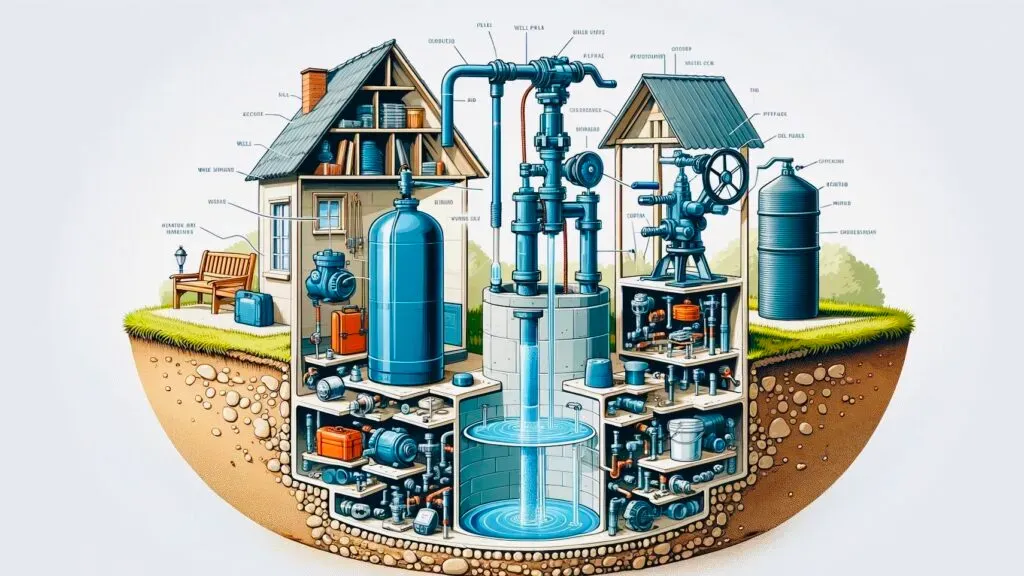
Here's the full picture: groundwater enters the well through the aquifer at the bottom of the casing. The submersible pump pushes it up through the casing, past the check valve, and out through the pitless adapter. From there, a buried supply line carries it to your pressure tank, which stores it under pressure. When you open a tap, the pressure tank delivers water instantly. When pressure drops, the pressure switch tells the pump to refill the tank. The cycle repeats, quietly and automatically, every day.
When every component is properly sized, installed, and maintained, this system runs so seamlessly that you barely think about it — which is exactly the point.
Maintenance Reminders
Each component in your well system has a lifespan, and none of them last forever. A few simple habits will help you get the most out of every part:
- Inspect the well cap at least once a year. Look for cracks, insect nests, or signs of tampering.
- Test your water annually for bacteria and nitrates. If you notice changes in taste, color, or odor between tests, don't wait — get it tested right away.
- Listen to your system. A pump that cycles on and off rapidly (short-cycling) often points to a waterlogged pressure tank or a failing pressure switch.
- Service your treatment equipment on schedule. Softener salt needs replenishing, filters need replacing, and UV bulbs lose effectiveness over time.
- Keep a maintenance log. Write down service dates, water test results, and any issues. It helps your technician diagnose problems faster and adds value if you ever sell the property.
Your well system is a collection of parts that depend on each other. When you understand what each piece does and keep an eye on the whole system, you're setting yourself up for decades of reliable, clean water — and that's a pretty great return on a little bit of knowledge.