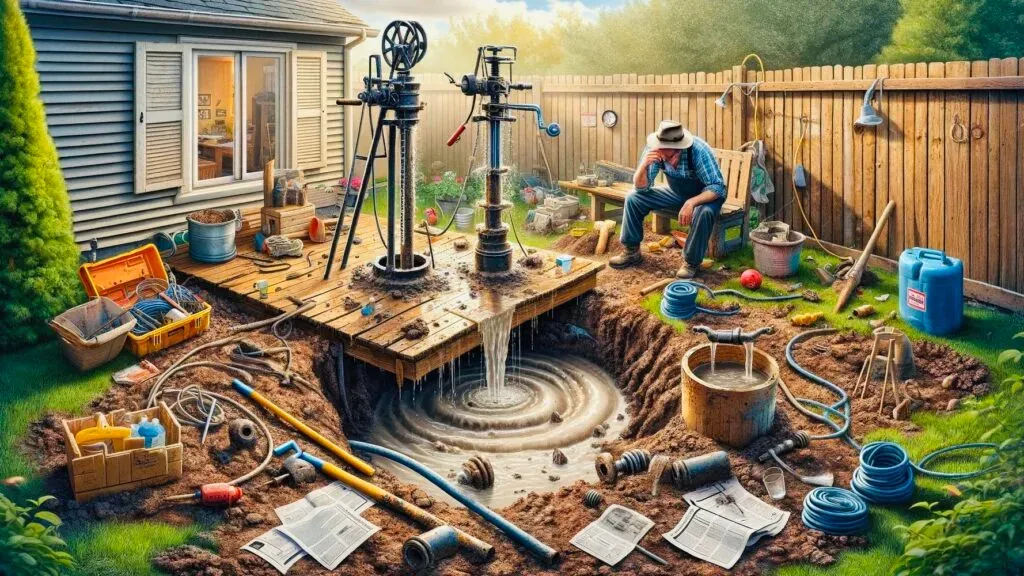
Why DIY Well Drilling Is So Tempting
We get it. You've seen the YouTube videos — a guy in a flannel shirt with a homemade rig punching a hole in his backyard and hitting water by lunchtime. It looks straightforward. And when you compare the price of a few hundred dollars in hardware-store parts to a professional drilling quote of $10,000 or more, the math seems obvious. Why wouldn't you try it yourself?
If you're the kind of person who likes to tackle projects on your own — and if you live in Eastern Washington, there's a good chance you are — the idea of drilling your own well has probably crossed your mind. But before you go down that road, let's talk about why it almost never works out the way people hope.
Eastern Washington Ground Is Not Beginner-Friendly
Here's the thing those YouTube videos don't mention: the geology matters enormously, and Eastern Washington's geology is particularly unforgiving for amateur drilling attempts.
Most of the land east of the Cascades sits on top of the Columbia Plateau basalt flows — layers upon layers of extremely hard volcanic rock. This isn't soft clay or loose sand that you can bore through with a simple auger. Basalt will chew up improvised equipment, stall underpowered rigs, and laugh at anything short of professional-grade rotary or air percussion drilling.
In many parts of Spokane, Lincoln, Adams, and Whitman counties, water-bearing aquifers sit 100 to 400 feet or more below the surface, buried beneath multiple basalt layers. Getting through that rock isn't a weekend project — it's a serious undertaking that demands the right tools and the right experience.
The Equipment Reality
Let's talk about what it actually takes to drill a well. Professional water well drilling rigs cost $100,000 or more — and that's for a reason. They're engineered to push through the kinds of formations we encounter in Eastern Washington. They deliver the torque, the downhole pressure, and the air volume needed to penetrate basalt and maintain a stable borehole.
The homemade and small portable rigs you see online? They can work — in very specific conditions. Soft soil, shallow water tables, and forgiving geology. That doesn't describe most of Eastern Washington. What typically happens is someone buys or builds a lightweight rig, gets 20 or 30 feet down, hits solid basalt, and grinds to a halt. Now they've spent money on equipment that can't finish the job and they still don't have water.
Washington State Legal Requirements
This is the part a lot of people don't realize until it's too late. In Washington State, well drilling isn't just a physical challenge — it's a regulated activity with real legal requirements:
- Licensed driller required: Washington law requires that water wells be constructed by or under the direct supervision of a licensed well driller. You can't legally drill your own water well as an unlicensed individual.
- Well construction standards: The state mandates specific standards for casing, grouting, well caps, and overall construction. These standards exist to protect groundwater from contamination — not just for your property, but for everyone who shares the aquifer.
- Department of Ecology reporting: Every well drilled in Washington must be reported to the Department of Ecology with a detailed well log. This includes depth, geology encountered, casing details, water level, and yield information.
Drilling without a license isn't just cutting corners — it's breaking state law. If the county or Ecology finds out, you can face fines, be required to decommission the well, and end up paying to have it done properly anyway.
Safety Risks You Can't Ignore
Well drilling is genuinely dangerous work, even for professionals who do it every day. For someone without training, the risks multiply fast:
- Cave-ins and borehole collapse: An unstable borehole can collapse without warning. If you're working near it with improvised equipment and no safety protocols, the consequences can be severe.
- Heavy equipment injuries: Drilling rigs involve rotating machinery, high-pressure systems, and heavy suspended loads. Professional drillers train extensively on safe operation. One mistake with unfamiliar equipment can cause life-changing injuries.
- Groundwater contamination: An improperly constructed well becomes a direct conduit for surface pollutants — fertilizer, animal waste, fuel, septic effluent — to reach the aquifer. This doesn't just affect your water. It can contaminate the groundwater supply for your neighbors and the wider community.
What Happens When DIY Goes Wrong
We've been called out to properties where homeowners attempted to drill their own wells. Here's what we typically find:
- An abandoned, partially drilled hole that wasn't properly sealed — creating a contamination pathway that needs to be professionally decommissioned.
- Money already spent on rental equipment, materials, and supplies that can't be reused or returned.
- Property damage from equipment that was too heavy for the terrain or positioned in the wrong location.
- A well that needs to be drilled from scratch because the DIY attempt can't be salvaged — wrong diameter, wrong location, or compromised by poor construction.
The painful truth is that fixing a failed DIY well almost always costs more than having it done right the first time. You're paying for the original materials, the decommissioning of the failed well, and then the full cost of a professional installation. What started as a way to save money ends up being the most expensive path.
What About Hand-Dug or Shallow Wells?
Some folks wonder about the old-fashioned approach — digging a shallow, large-diameter well by hand. In Eastern Washington, this is a particularly bad idea. Our basalt geology makes hand digging impractical beyond a few feet, and even if you could get deep enough, shallow wells in this region come with serious problems:
- They're highly susceptible to seasonal fluctuations and drought — and Eastern Washington's dry summers are no joke
- They're easily contaminated by surface water, agricultural runoff, and nearby septic systems
- They rarely produce enough water for a reliable household supply
- They still need to meet Washington State construction standards
A shallow, hand-dug well might have made sense a hundred years ago when people had fewer options. Today, it's not a viable water supply strategy for a home in Eastern Washington.
The Real Cost Comparison
Let's put some rough numbers on the table to make this concrete:
- Professional well drilling: $5,000 to $25,000 depending on depth and conditions — done right, done legally, done once.
- DIY attempt + professional fix: $2,000 to $5,000 in DIY equipment and materials, plus $500 to $2,000 to decommission the failed attempt, plus the full cost of professional drilling. You could easily end up spending $8,000 to $30,000 or more — and you went without water for months in the process.
The math doesn't lie. The "savings" from a DIY approach evaporate the moment something goes wrong — and in Eastern Washington basalt, something almost always goes wrong.
Let the Professionals Handle This One
We're all for self-reliance. Most of us at Spring Creek Drilling live on rural Eastern Washington property ourselves, and we understand the instinct to do things on your own. But well drilling is one of those jobs where the combination of legal requirements, geological challenges, safety risks, and technical complexity means hiring a licensed professional isn't just the smart choice — it's really the only practical choice.
If you're thinking about water for your property, give us a call. We'll come out, look at your land, and give you an honest estimate. No pressure, no sales pitch — just straightforward information from people who've been drilling wells in this part of Washington for years.