Spring Creek Drilling

If you're buying land or planning a home in Spokane, Stevens or Lincoln County, someone has probably told you that you'll need a "well permit." Here's the short answer: Washington doesn't issue a permit to drill a typical home well. What it does have is required paperwork, rules for how the well is built, and limits on how much water a well can use without a water right.
This guide walks through how it all fits together, from the notice Ecology gets before drilling to the county building permit, which is where most people actually run into the "permit" part.
The Notice of Intent: A Heads-Up, Not a Permit
Before a well is drilled, the Department of Ecology has to be told about it. The property owner or the owner's agent (usually the driller) files a notice of intent at least 72 hours before construction starts, listing the owner, the well's location and proposed use, the approximate start date, and the driller's name and license number (RCW 18.104.048).
It comes with a state fee: $200 for a well with casing under 12 inches, which covers a typical home well, or $300 for 12 inches or larger (RCW 18.104.055). We handle the notice of intent and the well report as part of the project.
What the notice is not: Ecology says plainly that "an NOI is not a permit, certificate, or application for a water right," and that it "does not represent approval or permission to use water from the well" (Ecology). The right to use the water comes from water law, covered below.
Construction Standards and a Licensed Driller
Instead of permitting each well, Washington regulates how every well is built, and it's unlawful to build one that doesn't meet the state's standards (RCW 18.104.030). The ones you're most likely to notice:
- Setbacks. At least 100 feet from a drainfield (including the reserve area), 50 feet from a septic tank, and 5 feet from a building, and never inside a garage, barn, storage building or house (WAC 173-160-171). The state rule has no property-line setback, but a neighbor's drainfield needs the same 100 feet.
- The surface seal. Bentonite or neat cement at least 18 feet deep around the casing, so surface water can't run down the outside of it (WAC 173-160-231).
- The wellhead. Casing at least 6 inches above the ground, and no well in a floodway or where water ponds (WAC 173-160-291).
Those rules shape where a well can go, which is why the exact spot is set on site, with setbacks and rig access in mind, before drilling starts. See choosing a well location.
State law also says who can build it: contracting to build a well without a state license is unlawful (RCW 18.104.030). Spring Creek Drilling holds WA driller license #3371. The exception is the owner exemption: you can personally build one well every two years on land you own or lease, for farm or single-family use, but you still have to meet the construction standards, file the notice, pay the fee and file the report (RCW 18.104.180). In our ground, that rarely goes well; see the pitfalls of DIY well drilling.
The Well Report and the Well ID Tag
Within 30 days of finishing, whoever built the well files a well report with Ecology (RCW 18.104.050). It records the tax parcel number, the depth, the casing and seal, each formation drilled through, the static water level and the tested yield (WAC 173-160-141).
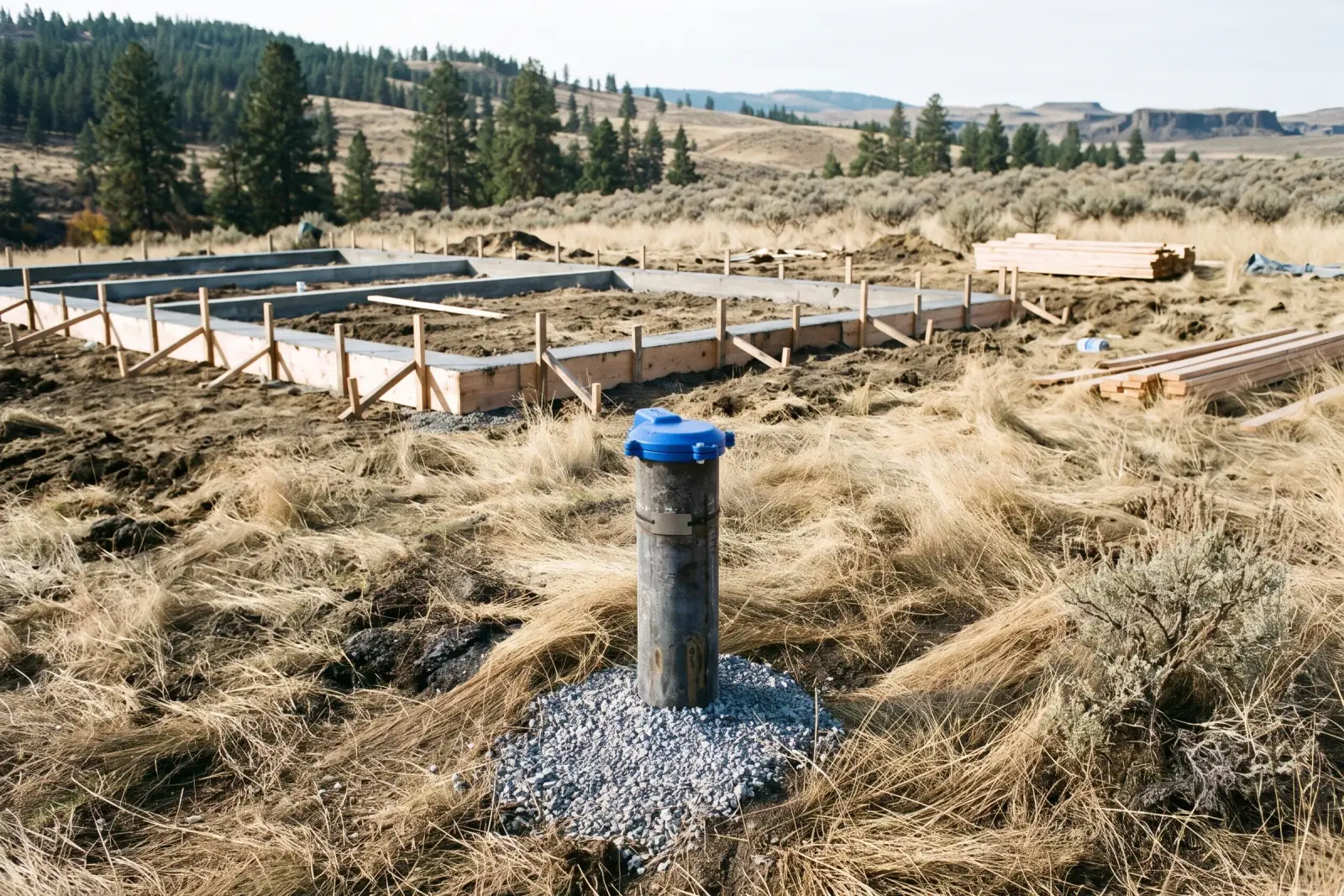
The driller also attaches an Ecology well ID tag, like the one in the photo above, within 30 days. The tag stays permanently on the casing, visible above ground, and its number goes on the report and on all later work. It's unlawful to tamper with or remove it except while the well is being altered (WAC 173-160-311). If you own an older well that was never tagged, the same rule makes that the owner's job, and Ecology supplies the tag on request.
Keep a copy of the report: your county will want it for the building permit, and a buyer will want it if you sell. Anyone can look one up in Ecology's Well Report Viewer by parcel number, address or tag number. More in understanding your well report.
Water Rights and the Permit Exemption
Here's the part that trips people up. In Washington, withdrawing groundwater generally takes a water right permit from Ecology. A typical home well skips that step because of the permit exemption in RCW 90.44.050, which covers four uses:
- Household use up to 5,000 gallons a day, including outdoor chores like washing the house or car.
- Watering a lawn or noncommercial garden of up to half an acre.
- Stock watering, with no daily cap. That's drinking water for the animals, not dust control, cleaning, or irrigating feed crops.
- Industrial use up to 5,000 gallons a day, which Ecology says can include a store or restaurant, or irrigation of a small commercial farm, nursery or garden.
A few details from Ecology's guide to the exemption (Ecology Publication 19-11-090): the 5,000 gallons is a daily maximum, not an average; the exempt uses can be combined on one property; and for a subdivision, the limits apply to the whole project, not to each well or lot. An exempt well isn't a lesser right, either. Ecology says "their use establishes a legal water right," subject to the state's priority system like any other.
When You Do Need a Water Right Permit
Using more water than the exemption allows, using it for any other purpose, or taking it from a surface water source "requires a water right permit from Ecology," and unauthorized use can bring fines of up to $5,000 a day (Ecology). The common cases:
- Irrigation beyond the exemptions: more than half an acre of lawn or noncommercial garden, or farm irrigation larger than the 5,000-gallon-a-day industrial exemption can cover.
- Commercial use over 5,000 gallons a day.
- A water system with 15 or more connections, which Ecology treats as municipal use.
Timing matters. A well that needs a water right can't be drilled until the permit is issued (WAC 173-160-121), and Ecology says water rights "can be difficult and expensive to obtain, and the process can take many years." Our agricultural well page covers irrigation and stock water in more detail.
Extra Rules in Parts of Our Area
Three parts of our service area add rules of their own. Our town pages say which apply where, and the county confirms it for your parcel.
Little Spokane and Colville watersheds
Under the state's 2018 streamflow law, a new home relying on a permit-exempt well in the Little Spokane (WRIA 55) or Colville (WRIA 59) watershed is limited to domestic use, with an annual average of 3,000 gallons a day. The county collects a $500 fee with the building permit and records the water restrictions on the property title (RCW 90.94.020). That includes areas around Deer Park, Chattaroy, Colbert and Mead, and the Colville valley around Colville and Chewelah. A permit-exempt well built before January 19, 2018 still counts as evidence of water for a building permit (RCW 19.27.097).
The Spokane Valley aquifer
Over the Spokane Valley-Rathdrum Prairie aquifer, state rules make municipal water suppliers "the primary sources of water for new uses" (WAC 173-557). If a supplier can't serve you in a timely and reasonable manner, a new permit-exempt well is possible, but its use has to be mitigated. Ecology's SVRP Aquifer Bank provides that mitigation free of charge, generally for a single home on a private well (Ecology Publication 15-11-011). See well drilling in Spokane Valley.
The Odessa Subarea
In the Odessa Subarea, in parts of Lincoln County, Ecology says groundwater levels "are declining rapidly in many places and as a result, groundwater is not available for new uses" (Ecology WRIA 43 summary). The subarea's management rule doesn't apply to wells withdrawing less than 5,000 gallons a day (WAC 173-130A-050), so a household well is still an option; new water rights for larger uses are not. See well drilling in Odessa.
The County Side: Proving Water for Your Building Permit
If there's a "permit" a well owner really runs into, it's this one. Anyone applying for a building permit for a building that needs drinking water has to show evidence of an adequate water supply. Outside a few specially regulated areas, a well report can serve as that evidence, but a pending water right application can't (RCW 19.27.097). Each county handles the details its own way:
- Spokane County: the Spokane Regional Health District reviews the well report, a pump test certification showing at least 1,440 gallons a day (one gallon per minute), and samples taken by an SRHD-approved sampler showing no coliform bacteria and nitrate at or under 10 mg/L (SRHD's water adequacy guide).
- Stevens County: Land Services asks for at least 800 gallons a day for a single home, held over four hours, plus results under two years old from a state-certified lab for coliform, nitrate, arsenic, lead and uranium. Its guide dates from 2018, so confirm with Land Services (Stevens County's potable water guide).
- Lincoln County: proof of potable water, such as the well log, goes with the septic permit, which comes before the building permit (Lincoln County's requirements).
Since the county wants the well report and test results before it issues a permit for a home on a new well, plan for the well early in your project. Our guides to how long it takes to get a well and testing a new well cover the order of steps and the tests.
Wells That Serve More Than One Home
Sharing a well with a neighbor or a second house adds a layer. Ecology says a group domestic system can supply up to 14 homes under the permit exemption, all within the same 5,000 gallons a day (Ecology Publication 19-11-090).
Drinking water rules come in too. The Department of Health treats any system that pipes water for people to drink as a public water system, except one serving only one single-family home, or four or fewer connections that all serve homes on the same farm (WAC 246-291-010). Small systems are called Group B, and the state's Group B rules generally don't apply to one or two connections unless the local board of health has adopted its own requirements or the department decides they're needed to protect public health (WAC 246-291-005). A public water supply well's location also has to be approved before construction begins (WAC 173-160-171).
If you're planning one well for more than one home, talk to your county's drinking water regulator before you settle on a site, and see our guide to sharing a well. Our commercial well page lists who that is in each county.
Start With a Free Estimate
So, do you need a permit to drill a well? For a typical home, not from the state. You need a licensed driller, a notice to Ecology, a well built to state standards, a report and tag afterward, water use within the exemption (or a water right), and your county's sign-off on the water before you build.
Getting started is easy. Send us the address or parcel number, and we'll review the well reports filed nearby and give you a free estimate. Most of our projects are scheduled within weeks, not months, and once we're on site, most wells take one to three days.