Spring Creek Drilling
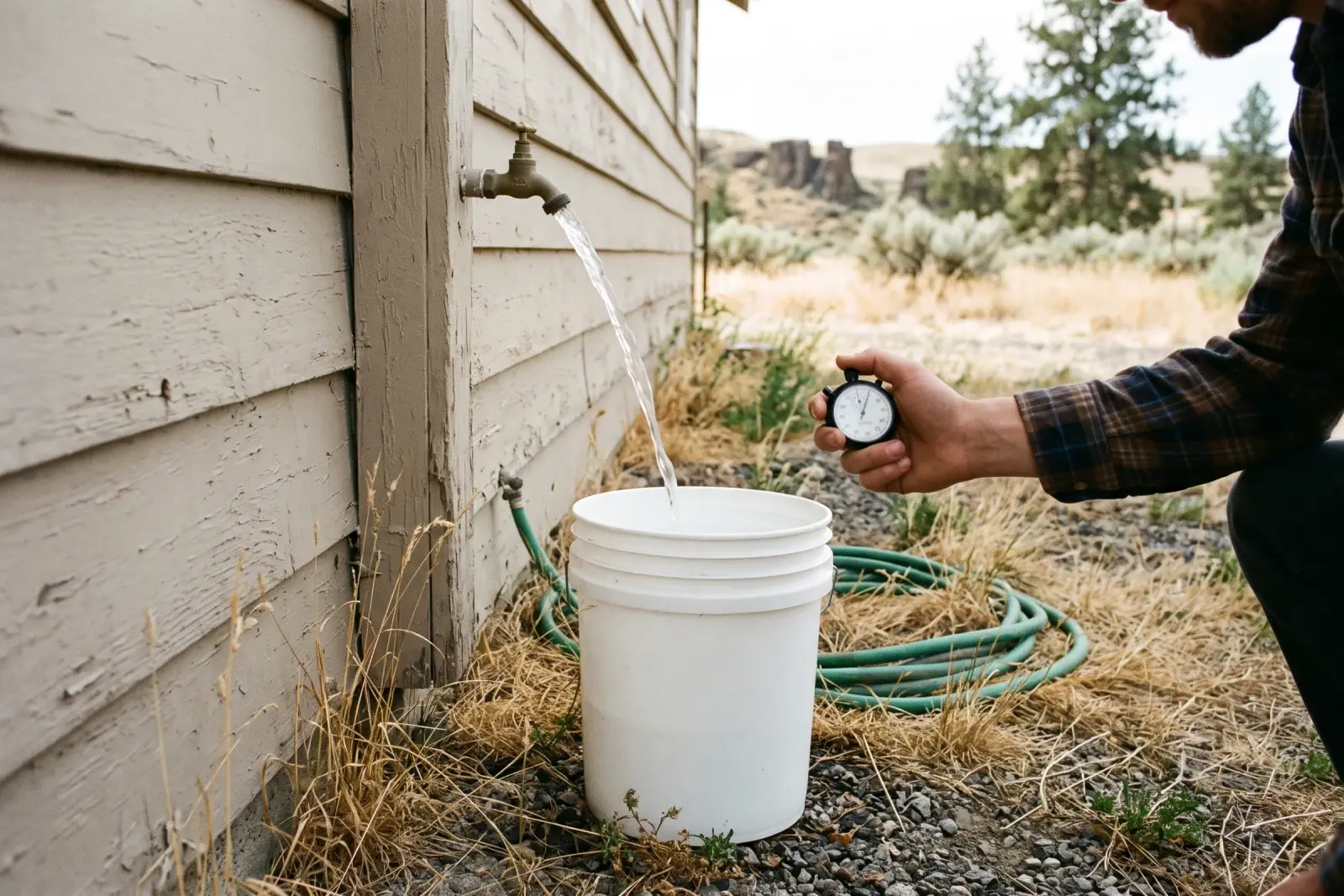
There's no single number a well has to hit. For a home, the common guidelines land between 5 and 7 gallons per minute (gpm), while the minimum for a building permit here is far lower: 1 gpm in Spokane County. A well below the guidelines can still serve a house, with a storage tank and a pump sized to the well.
Here's where those numbers come from, what a house really uses, and what wells in Spokane, Stevens and Lincoln counties typically produce.
How Many Gallons per Minute Is a Good Well?
The benchmarks, from highest to lowest:
- 7 gpm: what the National Ground Water Association says most homes need. If a well can't meet it, NGWA says you may need a storage system that holds "at least one day's supply of water for everyone in the household."
- 6 gpm and up: Penn State Extension's suggested minimum for most single-family homes. Its table grows with the house: 6 gpm for two bedrooms and one bath, 12 for three bedrooms and two baths, 14 for four bedrooms and two baths (Penn State Extension).
- 5 gpm over four hours: HUD's standard for a well serving a newly built home with an FHA-insured mortgage (24 CFR 200.926d).
- 1 gpm: the Spokane Regional Health District's minimum for a building permit, written as 1,440 gallons a day.
The short answer: 5 to 7 gpm is what the guidelines aim for in a typical home, and more helps with a bigger house or garden. A well below that isn't automatically a bad well; it needs a water system designed around it.
How Much Water Does a House Use?
Over a whole day, less than those rates suggest. The U.S. Geological Survey estimates each person uses about 80 to 100 gallons a day indoors (USGS). The EPA puts the average American family at more than 300 gallons a day at home, about 30 percent of it outdoors (EPA WaterSense).
The gpm guidelines are about busy times, when several things run at once. A standard showerhead uses 2.5 gpm and a standard bathroom faucet 2.2 gpm; WaterSense models use no more than 2.0 and 1.5 (EPA showerheads, EPA faucets). With standard fixtures, two showers and a sink running together top 7 gpm, and Penn State Extension lists a half-inch garden hose at 5 gpm.
Penn State also notes that peak periods "usually last from 30 minutes to 2 hours," and that an adequate water system has to keep up with a peak that long (Penn State Extension). Its example: without water-saving fixtures, a family of four could use more than 300 gallons in a two-hour Saturday morning, while a 1 gpm well supplies only 120 gallons in that time.
Well Yield, Recovery Rate and Pump Size: What's the Difference?
Three numbers get mixed up:
- Yield is what the ground delivers. Penn State Extension defines it as the most a well can be pumped, in gpm, "without lowering the water level in the borehole below the pump intake." The aquifer and the well set it, not the equipment.
- Recovery is how fast the water level climbs back after pumping stops. Slow recovery means water is entering the well slowly: in other words, low yield.
- The pump's rate is how much the pump can move. A bigger pump doesn't make more water; it only draws the well down faster. HUD's standards put it plainly: "Pump capacity shall not exceed the output of the well" (24 CFR 200.926d).
The well itself also holds water: Penn State Extension figures about 1.5 gallons per foot of standing water in a typical 6-inch well, so 100 feet of water is roughly 150 gallons. That's why a low-yield well may keep up with a short burst of use and fall behind during a long one.
How Well Yield Is Measured in Washington
Every new well gets a yield test when it's finished, and the result goes on the well report filed with Ecology. For a household well that doesn't need a water right, the test runs at a constant rate for at least an hour, using a pump, a bailer or air (WAC 173-160-321).
The report lists the tested rate in gpm, how long the test ran, and the drawdown, meaning how far the water level had dropped by the end. It also lists the static water level, where the water settles when the well is at rest (WAC 173-160-141).
Read the yield as the rate the well held on test day. It isn't necessarily the most the well could give, and it isn't a guarantee: an hour-long test can't show how a well does late in a dry summer, and the Spokane Regional Health District notes that groundwater conditions "change over time, which may affect future production rates." Our guide to understanding your well report walks through the rest of the form.
What Building Permits and Lenders Ask For
Each county sets its own minimum for the building permit on a home with a new well:
- Spokane County: the Spokane Regional Health District needs a pump test certification showing at least 1,440 gallons a day (one gallon per minute), along with the well report and coliform and nitrate results (SRHD water adequacy guide).
- Stevens County: Land Services asks for at least 800 gallons a day for a single home (1,600 for two), held over four hours, shown by a well log or a pump test. For low quantity, the county can approve storage. Its guide dates from 2018, so confirm with Land Services (Stevens County's potable water guide).
- Lincoln County: a well log (or a letter from a public water system) goes with the septic permit, which comes before the building permit. The county's published requirements don't give a flow figure, so ask what it wants to see (Lincoln County Building Division).
Those are permit minimums, not targets for daily life: a 1 gpm well passes in Spokane County, but as Penn State's example shows, it can't keep up with a busy morning without storage.
Lenders set their own rules. For a newly built home with an FHA-insured mortgage, HUD's minimum property standards say a private well system "should be capable of delivering a flow of 5 gpm over at least a 4 hour period" (24 CFR 200.926d). Lenders look at water quality too: the Northeast Tri-County Health District says "Most lending institutions require the seller to provide water-sampling results" (NETCHD). For any other loan, ask your lender early what it needs to see about the well and how recent the test has to be.
Typical Well Yields in Spokane, Stevens and Lincoln Counties
The state's well reports show what wells around here produced on test day. These are the median yields in Ecology's records through February 2025, from the reports that list a yield (half tested higher, half lower):
- Spokane County: 13 gpm across 4,276 reports. By community, medians run from 6 gpm around Newman Lake to 30 around Cheney.
- Stevens County: 7 gpm across 2,034 reports. By community, medians run from 4 gpm around Addy to 18 around Ford.
- Lincoln County: 20 gpm across 543 reports. By community, medians run from 14 gpm around Reardan to 35 around Edwall.
The typical well in all three counties is within or above the 5 to 7 gpm guidelines, but the spread is wide, and the ground explains much of it. In Stevens County, valleys hold glacial sand and gravel while most higher ground has bedrock at or near the surface, so a valley lot and a hillside lot can get very different wells. Around Deer Park, Colbert and Chattaroy, a well may finish in sand and gravel or continue into the rock below. Our well depths by town pages give each community's median yield where enough reports list one, and how deep will my well be? explains the ground in more detail.
How Much Water Does a Well Produce per Day?
Multiply the gpm by 1,440, the minutes in a day. Pumped nonstop, a 1 gpm well produces 1,440 gallons a day and a 5 gpm well 7,200. A family of four at 80 to 100 gallons each uses 320 to 400 gallons a day indoors, well under what even a 1 gpm well makes in 24 hours. That's why a low-yield well can work: the problem is timing, not the daily total, and storage bridges the gap.
Don't confuse any of this with the 5,000 gallons a day in Washington's permit exemption. That's a legal limit on how much household water a well can supply without a water right (RCW 90.44.050), and Ecology says it's "a maximum daily amount for all use days, not an average" (Ecology's permit-exempt well guide). It isn't a measure of what a well produces or a promise that it will find that much water. Spread over a day, 5,000 gallons is about 3.5 gpm.
In the Little Spokane and Colville watersheds, a new home on a new permit-exempt well is limited to an annual average of 3,000 gallons a day (RCW 90.94.020); town pages such as Colville say where that applies.
Low-Yield Well Solutions: Storage Tanks and Pump Sizing
A well below the guidelines can usually still supply a home. Penn State Extension's guide to using low-yielding wells describes the usual options:
- A storage tank. The well pump slowly fills a large, non-pressurized tank, and a second pump supplies the house from it. Penn State's rule of thumb is 100 gallons per person, ideally a full day's use, refilled overnight. The tank has to be protected from freezing, buried below the frost line or kept in a heated space.
- A pump sized to the well. With a storage system, Penn State says the well pump should be rated slightly below the well's yield, and recommends a low-water cutoff that stops the pump before the water level drops too far.
- Spreading out water use. Laundry through the week instead of all on Saturday, showers split between morning and night, and efficient fixtures. Penn State notes a front-loading washer alone saves more than 20 gallons a load.
A bigger pressure tank on its own won't fix low yield. Penn State says only about 20 percent of a pressure tank holds usable water, so a 42-gallon tank delivers about 8 gallons before the pump starts again.
The pump, storage tank, pressure tank and wiring are sized from the yield, depth and static water level on your well report. See the components of a well system for what each part does, and if you're still choosing land, buying land without a well covers reading nearby reports before you buy.
Find Out What the Wells Near You Produce
No one can promise a yield until a well is drilled, but the wells around your land are the best evidence there is. Send us the address or parcel number. We'll check the well reports nearest your land and give you a free estimate. Those reports show how deep the wells went and what they produced, so you can see early whether storage might be part of the plan.
Most of our projects are scheduled within weeks, not months; our guide to how long it takes to get a well covers each step to the building permit. Request your free estimate.