Spring Creek Drilling
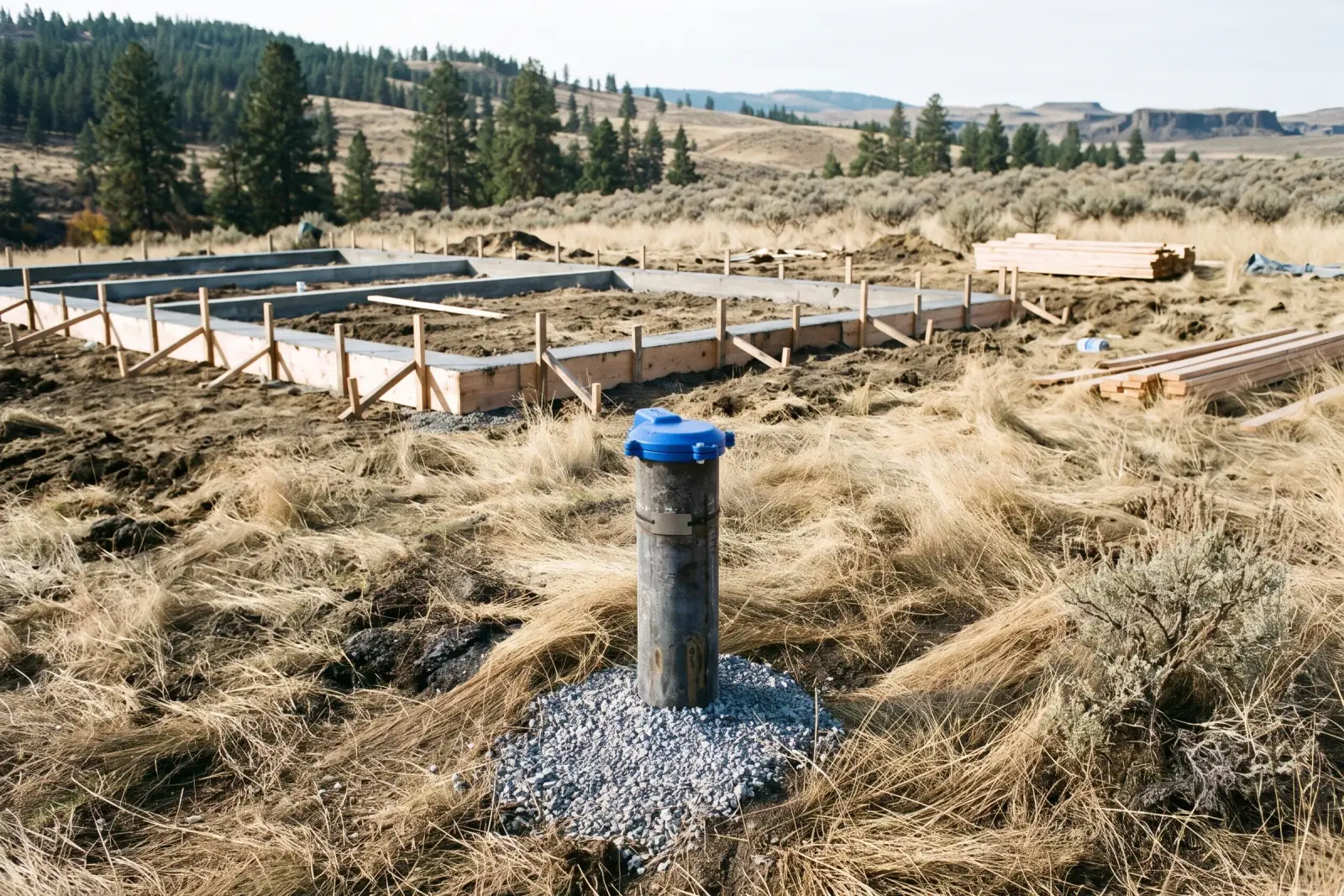
If you're building a home on rural land, the well sets the pace for a lot of what follows. In Spokane, Stevens and Lincoln counties, the county wants proof of water before it issues a building permit for a home on a well, so the well has to be drilled, tested and documented first.
Drilling is the quick part: once we're on site, most wells take one to three days. The rest depends on scheduling, on other steps (the pump system, a lab, the county) and, in some places, on extra water rules. Here's each stage in order, who handles it, and how long it takes where there's a real number to give. For the bigger picture, start with our beginner's guide to drilling a well.
The Timeline at a Glance
- Free estimate: from us; just send the address or parcel number.
- Scheduling: most of our projects are scheduled within weeks, not months.
- Notice of intent: filed with Ecology at least 72 hours before drilling.
- Siting: on site, before drilling.
- Drilling and yield test: most wells take one to three days on site.
- Well report and well tag: within 30 days of finishing.
- Pump system: after drilling, once power reaches the well.
- Water samples: the lab's turnaround.
- Proof of water and building permit: the county's review (in Spokane County, the health district's).
Before Drilling: Estimate, Schedule and Paperwork
The free estimate
Take this step first. Send us the property's address or parcel number and what the water is for. We look up the well reports filed around yours, which show how deep those wells went, what they were drilled through and what they produced, and give you an estimate. You can browse the same records yourself in Ecology's Well Report Viewer.
There's no reason to wait until you've closed on the land or finished your house plans: an expected depth and price helps while you're still setting a budget. Our cost guide covers what else to plan for.
Getting on the schedule
Once you decide to go ahead, we put you on the calendar. Most of our projects are scheduled within weeks, not months. If you have a fixed date to work around, such as a closing or a builder's start date, tell us when you book.
The notice of intent
Washington doesn't require a state permit to drill a home well, but Ecology has to receive a notice of intent at least 72 hours before construction starts. The property owner or the owner's agent files it, and the agent is usually the driller (RCW 18.104.048). We handle the notice of intent and the well report as part of the project. The state fee is $200 for a well with casing under 12 inches (RCW 18.104.055). The notice isn't a permit or a water right (Ecology), so there's no approval to wait for, just the 72 hours. Our guide to well permits covers the rest of the paperwork.
Siting the well
The exact spot is chosen on site before drilling, where rig access and the state's setbacks get settled: at least 100 feet from a septic drainfield (including an approved proposed drainfield and its reserve area), 50 feet from a septic tank, and 5 feet from any building (WAC 173-160-171). That includes a neighbor's drainfield. If your septic design isn't finished, know roughly where the drainfield and reserve area will go before the well site is fixed, so you don't have to move one later. Our guide to choosing a well location goes deeper.
Drilling and the Yield Test
Once we're on site, most wells take one to three days. Depth and ground are the big variables: a deeper well takes more drilling, and the hard basalt under Lincoln County, the West Plains and much of southern and western Spokane County takes longer to drill than softer ground. Our well depths by town show what's typical near you.
When the well is finished, it gets a yield test, and the result goes on the well report. For a household well that doesn't need a water right, that test runs for at least an hour at a constant rate, using a pump, a bailer or air (WAC 173-160-321). It's the first real measure of what your well produces. Our guide to drilling rigs covers what drilling day looks like.
The Well Report and Well Tag
The well report is filed with Ecology within 30 days of finishing the well (RCW 18.104.050). Within the same 30 days, an Ecology well ID tag goes on the casing, with a number that matches the report (WAC 173-160-311).
Keep a copy with your permit paperwork; it's the first item on Spokane County's list below, and the Spokane Regional Health District notes you can get one from your driller or Ecology's Well Report Viewer. Our guide to understanding your well report explains what's on it.
The Pump System and Water Samples
Pump, pressure tank and wiring
A new well doesn't deliver water to anything until a pump system is in: the submersible pump, pressure tank and wiring. How soon that happens depends on scheduling and on your site, such as getting power to the well and trenching the line to the house. Our guide to the components of a well system explains what goes in.
Water samples and lab results
Spokane and Stevens counties want lab results before they sign off, and each lab sets its own procedures. Before sampling, ask the lab how to collect the sample, how soon it has to arrive, which days it accepts samples, and how long results take. Coliform and nitrate tests cost $21 to $55 each, and the state Department of Health's list of certified labs includes three in the Spokane area and a Lincoln County lab in Davenport that tests for coliform (DOH lab list).
In Spokane County, the samples have to be collected by an SRHD-approved water sampler and tested at an accredited lab; SRHD lists approved samplers on its private wells page. On the West Plains, Ecology also advises testing new wells for PFAS at an accredited lab using EPA Method 533 (Ecology advisory). Our checklist for testing a new well covers sampling and the first year of tests.
Proof of Water and Your Building Permit
Spokane County
The Spokane Regional Health District reviews water adequacy before the county issues a building permit. You email SRHD the well report, its pump test certification form showing at least 1,440 gallons a day (one gallon per minute), coliform and nitrate results, and the review fee. Once SRHD approves them, it notifies the building department (SRHD water adequacy guide).
The guide doesn't give a review time, so ask SRHD. What adds time is a sample that doesn't pass. Coliform has to be absent; if it isn't, the well can be resampled. Nitrate has to be 10 mg/L or less, and if it isn't, the well can be resampled once and the two results averaged. If the water still doesn't pass, SRHD can approve the well with a deed notice (plus an approved treatment unit, for coliform). The owner signs that notice in person at SRHD, notarized, and SRHD won't approve the building permit until it has it.
Stevens County
Land Services asks for at least 800 gallons a day for a single home (1,600 for two), held over four hours, shown by a well log, a pump test by a licensed driller or pump installer, or an owner's pump test on the county's form. It also wants results for coliform, nitrate, arsenic, lead and uranium from a state-certified lab, less than two years old. For low quantity the county can approve storage, and for low quality, treatment with a recorded notice. The guide dates from 2018, so confirm the current requirements with Land Services (Stevens County's potable water guide).
Lincoln County
In Lincoln County, the order matters. The septic permit needs a well log (or a letter from a public water system), and the residential building permit needs the septic permit (Lincoln County Building Division). So the well report is the first piece of paperwork you'll want in hand. The county's building permit checklist also lists proof of potable water (Lincoln County's requirements), so ask what it wants to see from a new well when you apply.
When It Takes Much Longer
Irrigation that needs a water right
A home well works under the state's permit exemption: household use up to 5,000 gallons a day, stock watering, and watering up to half an acre of noncommercial lawn or garden (RCW 90.44.050). Irrigating more than that needs a water right permit from Ecology, issued before the well is drilled. Ecology says water rights "can be difficult and expensive to obtain, and the process can take many years." If irrigation is part of your plan, sort that out first. More on farm wells and water rights.
Over the Spokane Valley aquifer
Here the order changes. For permit-exempt wells over the Spokane Valley-Rathdrum Prairie aquifer, Ecology says the process "starts with a building permit request": the building department checks whether any part of your parcel is inside the aquifer boundary. If a public water supplier can serve you "in a reasonable and timely manner," you connect, and the rule doesn't apply. If not, you send Ecology a request for mitigation water. If water is available, Ecology issues a release letter that holds water for your project for up to three years (renewable while your building permit is valid), free for a single home. Before the certificate of occupancy, you request a Certificate of Mitigation, which is recorded with the County Auditor for a fee (Ecology publication 15-11-011; WAC 173-557-020). The guide doesn't give a review time, so start before you book drilling. Our Spokane Valley page has more.
The Little Spokane and Colville watersheds
This is a fee and a limit more than a wait. In the Little Spokane (WRIA 55) and Colville (WRIA 59) watersheds, a new home on a new permit-exempt well is limited to an annual average of 3,000 gallons a day (no more than 5,000 on any day), and the county collects a $500 fee with the building permit. Homes relying on wells drilled before January 19, 2018 stay under the older rules (RCW 90.94.020; Ecology's WRIA 55 summary). Town pages such as Deer Park and Colville say which rules apply there.
Tips for Keeping Your Schedule on Track
- Get the estimate early, before you finalize house plans or a construction loan schedule.
- Check your parcel's water rules first. Over the Spokane Valley aquifer, or for irrigation beyond the exemption, the extra steps come before drilling.
- Plan the pump system when you schedule drilling. Power to the well and the trench to the house take time too.
- Line up the lab, and in Spokane County an SRHD-approved sampler, ahead of time.
- Keep one folder. The well report, well tag number, pump test paperwork and lab results are what the county asks for, and you'll want them again if you ever sell.
Start With a Free Estimate
The first step costs nothing. Send us the address or parcel number, and we'll review the well reports filed nearby, give you a free estimate, and tell you where we can fit you on the schedule. You can also call or text (509) 319-4713. We drill wells across Spokane, Stevens and Lincoln counties from our base in Reardan.